World of Tanks explained: how the game actually works
This article is funded by advertising. Some links on this page are partner links: if you follow one and sign up or install the game, Boyuk Group, s.r.o. may be paid a commission by an affiliate network. You pay nothing extra, and World of Tanks itself remains free to download and play.
The commission does not change what is written here. Our editorial policy explains how we separate the two, and the affiliate disclosure sets out the arrangement in full.
World of Tanks is easy to install and genuinely hard to read. Most of what decides a battle is invisible to a new player: the angle of a plate, who can see whom, and the arithmetic of the economy behind the garage. This article explains those mechanics rather than selling them, and says plainly where the game is weakest.
- What it is
- A free-to-play, team-based armoured-vehicle game for Windows PC
- Developer & publisher
- Wargaming (the CIS version has been operated separately by Lesta Games since 2022)
- First released
- August 2010 in the CIS region; April 2011 in Europe and North America
- Core mode
- Random Battles, fifteen players per side
- In-game nations
- Eleven, each with its own research branches
- Vehicle tiers
- I to X
- Cost to play
- Nothing. Optional purchases affect earnings and convenience
- Related but separate
- World of Tanks: Modern Armor (console) and World of Tanks Blitz (mobile / PC)
In this article
- What World of Tanks is
- Three different games, one name
- Armour: angle beats thickness
- Shells: four ways through a plate
- Where the armour is thin
- Vision: the invisible half
- The five vehicle classes
- What one battle looks like
- Progression and the grind
- What free-to-play costs
- Is it pay-to-win?
- Who it suits, and who it does not
- Getting started
- Corrections to this article
- Sources
What World of Tanks is
World of Tanks is a team game in which fifteen players on each side drive historically inspired armoured vehicles around a map roughly a kilometre square and try to destroy each other. It is free to download, free to install and free to keep playing; money buys faster progress and better in-game earnings, not a bigger gun.
What separates it from most shooters is the pace and what the pace is for. Vehicles are slow, guns reload in seconds rather than fractions of a second, and a single mistake in positioning is usually fatal. The game rewards patience, map knowledge and an understanding of armour geometry far more than reaction speed. Players who arrive expecting a fast first-person shooter with tanks in it tend to leave within a week; players who enjoy the slow build of a good position tend to stay for years.
It is also old. The game launched in 2010 and is still receiving roughly monthly updates on PC more than fifteen years later. That longevity cuts both ways: the systems are deep and thoroughly documented by the community, and they are also layered on top of each other in ways that are not always explained inside the client.
Three different games, one name
This is the single most common source of confusion, and it is worth getting right before you install anything. “World of Tanks” refers to at least three distinct products that do not share accounts, progress or purchases:
| Product | Platform | What it is |
|---|---|---|
| World of Tanks | Windows PC | The original. The deepest systems, the largest roster, the mechanics described in this article. |
| World of Tanks: Modern Armor | PlayStation, Xbox | The console game. Built from the same idea but balanced and updated separately, with its own content. |
| World of Tanks Blitz | iOS, Android, PC, Nintendo Switch | A lighter, faster seven-versus-seven version designed for short sessions on a touchscreen. |
Progress in one does not carry to another. Buying something in Blitz does not give you anything on PC. If a guide, a video or a statistic does not say which version it is talking about, treat it with suspicion — numbers differ between them.
One more split. Following Wargaming’s withdrawal from Russia and Belarus in 2022, the CIS version of the PC game was transferred to a separate operator, Lesta Games, and rebranded. It is now a different service with its own patches and balance. Accounts and regions are not interchangeable.
Armour: angle beats thickness
The mechanic that surprises most new players is that the number written on a plate is not the number that matters. What matters is how much steel a shell has to travel through to get out the other side, and that depends on the angle at which it arrives.
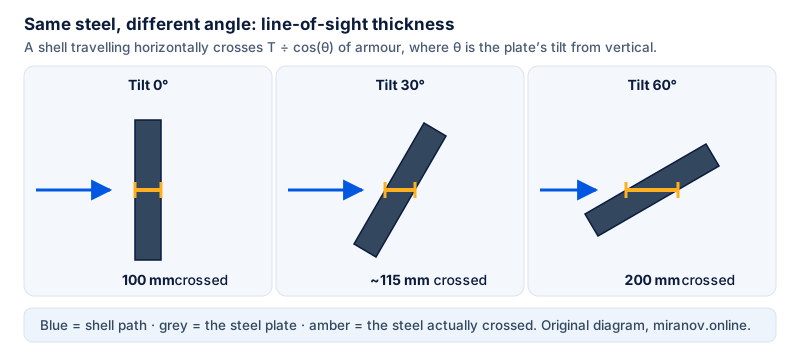
A hundred millimetres of steel standing straight up is a hundred millimetres of problem. Tip that same plate back sixty degrees and a shell arriving horizontally has to cross two hundred. Nothing was added: the geometry did the work. This is why the flat, upright slabs of early-1940s designs are so much easier to punch through than the sharply raked plates that came later, and it is why the single most useful habit a new player can build is angling — turning your hull thirty to forty degrees away from the enemy so that they see a slope instead of a wall.
The corollary is that shooting a sloped plate is a waste of a reload. Above a certain arrival angle the shell stops trying to penetrate and simply skids off, a ricochet, and does no damage at all. Two partial get-outs exist. First, the game applies a small amount of normalisation, nudging the shell slightly towards the perpendicular on impact, which helps a little at moderate angles. Second, a large enough calibre relative to the plate can overmatch it, ignoring the angle rules entirely; this is why oversized guns sometimes punch straight through a thin, steeply sloped roof or side that should have bounced them. The exact thresholds for both are tuned by the developers and have been adjusted over the years, so treat any specific figure you read as version-dependent.
Also in the calculation: the game models spaced armour and bolt-on screens — a thin outer plate standing off from the hull, which can strip the effect from some shell types before they reach the real armour. It does not model modern composite or reactive armour; the vehicles in the game predate it.
Want to see the armour model for yourself?
The client includes an armour-inspection view that colours every plate by thickness. It is free to install and you can look at it without playing a single battle.
Open the World of Tanks offer pagePartner link · advertisementPartner link. If you install the game through this link, Boyuk Group, s.r.o. may receive a commission from the affiliate network. It costs you nothing extra, and the game is free to download and play either way.
Shells: four ways through a plate
Each gun carries a mix of shell types, and the choice is a real decision rather than a strictly-better upgrade. The four families behave differently:
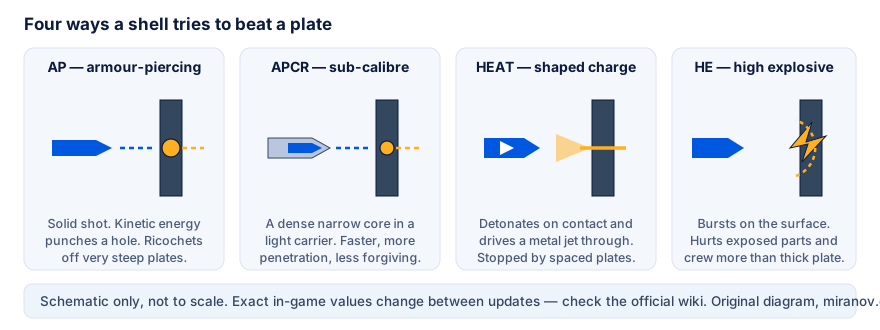
- AP (armour-piercing). A solid shot that works by kinetic energy. The default on most guns, the cheapest, and the most forgiving of a slightly imperfect angle.
- APCR (armour-piercing composite rigid). A dense, narrow core carried inside a lighter body. It flies faster, so it leads less at range, and it penetrates more — but it is less tolerant of angled plates and it costs considerably more.
- HEAT (high-explosive anti-tank). A shaped charge that detonates on contact and drives a thin metal jet through the armour. It does not care about your gun’s velocity, which makes it useful on low-velocity guns, but spaced armour, tracks and screens can set it off early and waste it.
- HE (high explosive). Bursts on the surface. Against thick frontal armour it does very little; against thin roofs, open-topped vehicles, exposed modules and crew it can do a great deal. On some British guns a variant, HESH, behaves similarly with higher nominal penetration.
The shells with the highest penetration are generally the expensive ones, and this is the hinge on which the game’s long-running pay-to-win argument turns. We come back to that below.
Where the armour is thin
Almost every vehicle has somewhere that is easier to hurt than the place a beginner instinctively aims at, which is the middle of the biggest flat surface. Some tendencies hold widely enough to be worth knowing as a starting point.
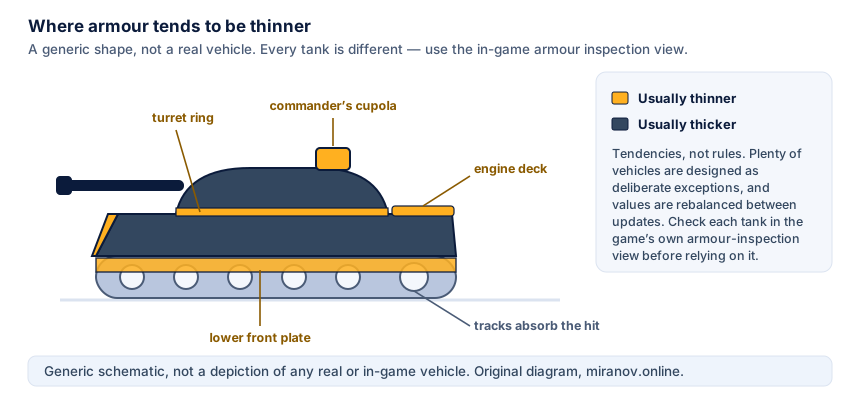
The lower front plate is usually flatter and thinner than the glacis above it. The commander’s cupola is a small raised box that is frequently softer than the turret face it sits on. The turret ring, where turret meets hull, is a narrow join. The engine deck at the back is overhead armour and thin by definition, which is why plunging fire from artillery hurts. And the tracks will absorb a hit without letting it through to the hull — which is a defensive tool as much as a target, since deliberately presenting a track to an incoming shell is a legitimate way to survive one.
Do not take any of this as gospel for a specific tank. The only reliable method is the armour-inspection view in the client, which shows the real values for the version you are actually running.
Vision: the invisible half
More battles are decided by who sees whom than by who shoots better. The game runs a full spotting system: a vehicle you have not detected is simply not drawn on your screen, even if it is sitting in the open thirty metres away and your teammate can see it perfectly.
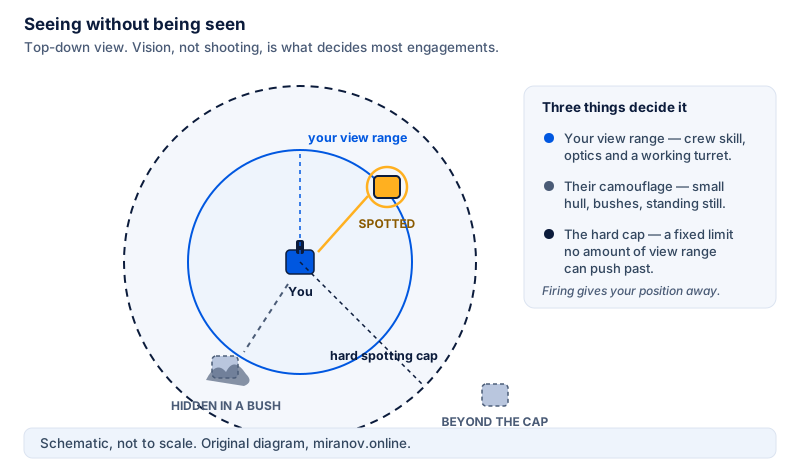
Three variables interact. Your view range comes from the vehicle, the optics you fit and how well trained your crew is. Their camouflage comes from the size of their hull, whether they are moving, whether they have just fired, and whether they are behind foliage — bushes genuinely conceal you, and stop concealing you the moment you shoot through them. And there is a hard cap: past a fixed distance nothing can be spotted by vision no matter how good your optics are, which is why stacking view range has diminishing returns and why teams need someone to drive forward and look.
This is the whole job of a light tank, and it is why a player who finishes a battle with no kills can still have been the most valuable vehicle on the team. Spotting damage — damage dealt by your teammates to vehicles only you can see — is tracked and rewarded.
The five vehicle classes
Vehicles are sorted into five classes. The class does not dictate everything — the spread inside each one is enormous — but it tells you what job the game expects you to do.
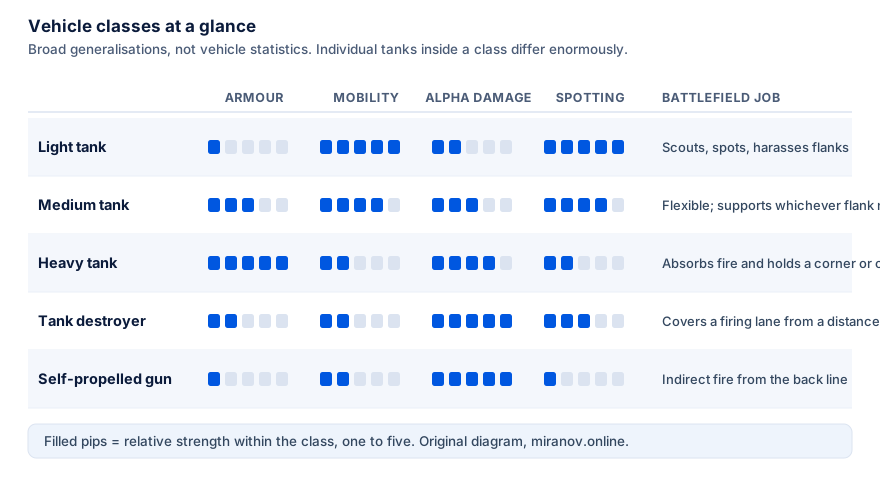
Light tanks are fast, fragile and hard to see; they exist to find the enemy and stay alive while their team shoots at what they found. Medium tanks are the generalists and, for most players, the easiest class to be useful in. Heavy tanks absorb fire and hold a corner, which is more about knowing when to expose yourself than about the thickness of the plate. Tank destroyers trade turrets and mobility for a big gun down a fixed lane. Self-propelled guns — artillery — fire indirectly from the back of the map; they are also, consistently, the most divisive thing in the game, and a substantial part of the player base would remove them entirely.
Our fuller breakdown of the classes goes through what each one actually does in a battle, and which ones are hardest to learn.
What one battle looks like
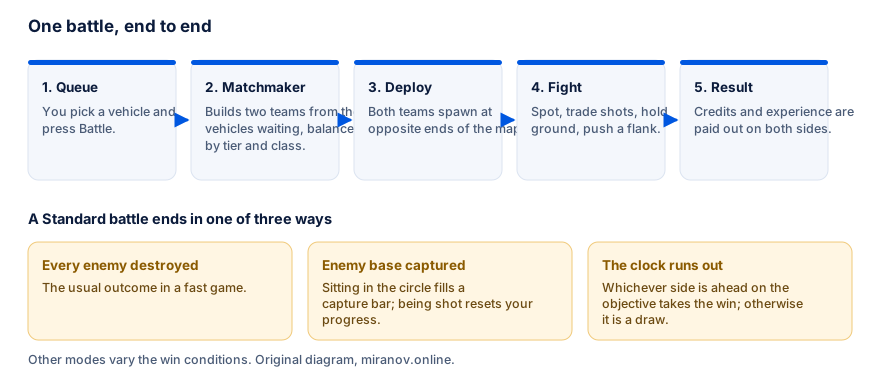
You pick a vehicle, press the battle button, and the matchmaker assembles two teams of fifteen from whoever is waiting, balancing them by tier and by class. Both sides spawn at opposite ends of the map. A standard battle ends when one team is destroyed, when one team captures the other’s base by sitting in a marked circle long enough — taking damage resets your capture progress — or when the clock runs out, in which case whoever is ahead on the objective wins.
Beyond Random Battles the mode list is long and rotates. At the time of writing it includes ranked seasons, clan-versus-clan play on a persistent map, fortified-area battles between clans, and periodic large-format seasonal modes. There are also training rooms, in which you can drive around an empty map with friends, and a tutorial area for new accounts. Because the seasonal line-up changes several times a year, check the in-game calendar rather than an article for what is running now.
A correction to an earlier version of this page: we previously described a mode called “Squad Battles” and said platoons hold four players. Neither is right. There is no mode by that name, and a platoon on PC is up to three players. See corrections.
Progression and the grind
Two currencies run in parallel and do different jobs. Experience unlocks things; credits buy them. You cannot substitute one for the other without paying.
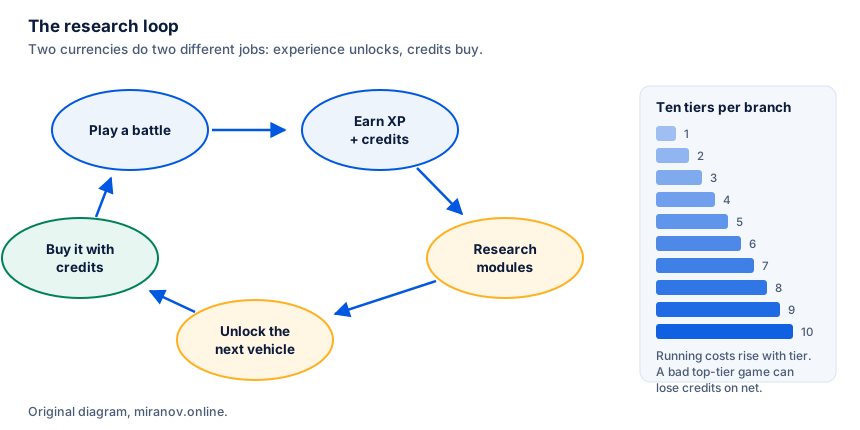
Each vehicle sits in a branch. Playing it earns experience that you spend first on its own modules — a better gun, engine, tracks and radio, which is usually the difference between a miserable tank and a decent one — and then on unlocking the next vehicle up the branch. Credits then have to be found to actually buy it, along with its equipment and a crew.
The part nobody mentions in a trailer is the economy at the top. Repair bills and ammunition costs scale with tier faster than credit income does, so a bad game in a tier X vehicle can end with you poorer than you started. Most long-term players fund their top tier by farming credits in a mid-tier vehicle they own for that purpose. If a friend tells you they are “grinding credits”, this is what they mean, and it is a real and deliberate part of the design.
Crews carry their own progression. A crew accumulates experience, trains skills and perks, and moving a trained crew into a new vehicle without retraining them costs you performance. Crew quality is a large, poorly signposted contributor to how a tank feels.
What free-to-play costs
Nothing, to start. The client is free, the account is free, and every tech-tree vehicle up to tier X can be reached without spending. What money changes is the rate, and a few conveniences.
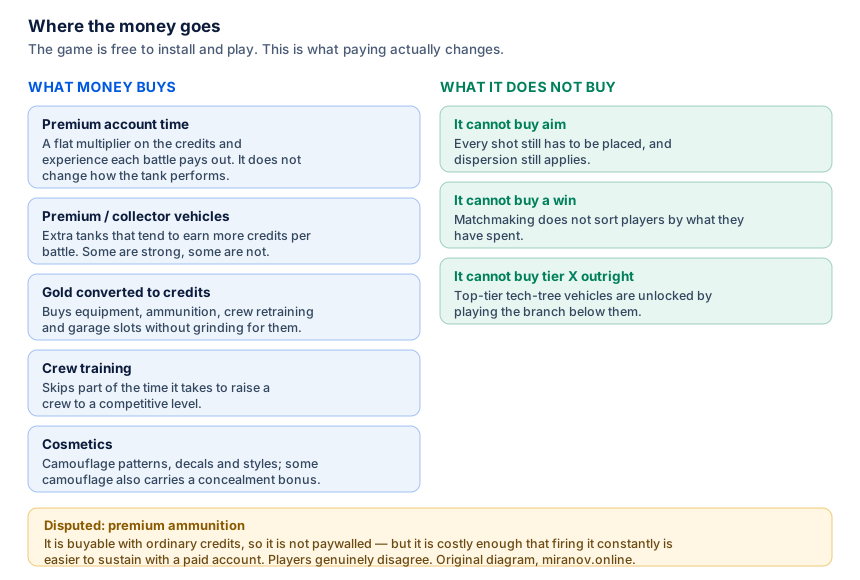
A premium account multiplies the credits and experience each battle pays. Premium and collector vehicles are extra tanks that generally earn better; some are strong, some are not, and they are balanced as a separate pool from the tech tree. Gold, the paid currency, converts to credits and pays for equipment, retraining and garage slots. Cosmetics are cosmetic, though some camouflage patterns also carry a small concealment bonus, which is a design choice worth being aware of.
What it buys, in one sentence: time. Whether that is worth money to you is a personal question and we are not going to answer it for you.
Is it pay-to-win?
An earlier version of this article flatly said the game has “no pay-to-win elements”. That was too strong, and we have removed it. The honest position is that this is contested, and reasonable players disagree.
The case that it is not: matchmaking does not sort players by spending. No purchase raises a gun’s penetration or a plate’s thickness. Premium vehicles are deliberately balanced below their tech-tree equivalents in combat terms and compensated with earnings. The highest-tier vehicles cannot be bought outright. A skilled free player beats an unskilled paying one nearly every time.
The case that it is: premium ammunition is the crux. It is buyable with ordinary credits, so it is not behind a paywall — but it costs several times what standard ammunition costs, and firing it constantly is far easier to sustain on a premium account with a premium tank earning for you. In practice a player with money loads whatever shell the situation calls for, and a player without it thinks twice. Equipment, consumables and crew training point the same way: everything is reachable without paying, and everything is faster and less stressful with a subscription.
Our reading is that the game is not pay-to-win in the strict sense of buying power that cannot be earned, but it is firmly pay-for-convenience, and at high tiers the convenience is large enough that some players reasonably experience it as the same thing. You should try it and decide for yourself, which costs nothing.
Who it suits, and who it does not
It suits you if you like slow, positional games; if the satisfaction of a shot that lands where you meant it to is worth waiting eleven seconds for; if you enjoy learning a system that does not explain itself; or if you have an interest in twentieth-century armour and want to drive the vehicles.
It will probably not suit you if you want quick matches and constant action, if you dislike being killed by something you never saw, or if you are not willing to spend your first few dozen battles being comprehensively beaten while you learn. The learning curve is genuinely steep and the game is not good at flattening it.
The player base is also, after fifteen years, experienced. A new account is entering a game where the average opponent has thousands of battles. Low tiers are protected from the worst of this, but the adjustment is real.
Getting started
If you want to try it, the sensible order is: install the client, complete the tutorial content, then play tiers I to IV of a single nation until the controls stop needing thought. Pick one branch and stay on it — spreading experience across five branches at once is the most common way new players stall. Do not buy anything for at least a week; you cannot tell whether a premium tank suits you before you know what you like.
System requirements are modest by current standards, and the client offers a low-detail rendering mode for older machines. We are not going to quote specific minimum specifications here because they change with major updates — the official download page lists the current ones.
Our beginner’s guide goes through the first ten hours in more detail, and the glossary translates the shorthand you will meet in chat.
Ready to try it?
The client is free, the account is free, and you can uninstall it on the same afternoon if it is not for you. Nothing in this article changes if you do or do not.
Open the World of Tanks offer pagePartner link · advertisementPartner link. If you install the game through this link, Boyuk Group, s.r.o. may receive a commission from the affiliate network. It costs you nothing extra, and the game is free to download and play either way. We link through an affiliate network, so the destination may show a tracking address before it reaches the game.
Corrections to this article
This page replaces an earlier version that contained several claims we could not stand behind. In keeping with our corrections policy we list them rather than quietly deleting them.
| The earlier version said | What we changed, and why |
|---|---|
| “over 300 unique tanks … ten different nations” | There are eleven in-game nations on PC, not ten. The vehicle count has grown well past 300 and keeps changing, so we now give no number and point to the official tech tree instead. |
| “Squad Battles allow you to play with a full platoon of four” | Removed. There is no mode called Squad Battles, and a platoon on PC holds up to three players. |
| “supports PC, Mac, and console platforms” | Corrected. The official macOS client for the PC game was discontinued; console and mobile are separate products with separate accounts, not platforms of the same game. |
| “nearly fifteen years after launch” | It is more than fifteen years; the game launched in 2010. |
| “a free-to-play game with no pay-to-win elements” | Removed as overstated. Replaced with a section setting out both sides of a genuinely contested question. |
| “the type of armor (homogeneous vs. composite)” | Corrected. The game models plate thickness, angle, spaced armour and screens. It does not model composite armour; the vehicles predate it. |
| “find a match … at any time of day, in a matter of seconds” | Hedged. Queue times vary by region, tier, class and time of day, and we have no way to verify a universal figure. |
| “Updates are released … typically every few weeks” | Changed to roughly monthly on PC, which matches the published patch history. |
| Framing as a “reader-submitted story” | Removed in full. It was not submitted by a reader. The article is written and signed by our editor, and there are no testimonials, user reviews or star ratings anywhere on this site. |
| “No credit card required.” | Reworded. It is true that no payment is needed, but the phrasing belongs to a sales page, not an explainer. |
If you find something else wrong here, write to info@miranov.online and we will check it.
Sources
Mechanics in this article were checked against the publisher’s own material. Where anything here diverges from the game publisher’s own current information, the publisher’s information prevails. Games are patched; articles are not patched as often.
- Official World of Tanks site (Europe) — worldoftanks.eu: current vehicle roster, game modes, store contents and system requirements.
- Official Wargaming game wiki — wiki.wargaming.net: armour, penetration and spotting mechanics.
- Official update notes and patch history published on the World of Tanks portal: release cadence and mode rotation.
- Wargaming corporate announcements, 2022: the transfer of the CIS service to a separate operator.
- World of Tanks Blitz and World of Tanks: Modern Armor official product pages: confirmation that the three products are separate, with separate accounts.
Last reviewed 22 September 2026 by Lisa Anderson. We re-check this page when the game receives a major update. Figures 1 to 8 are original diagrams drawn for this site; no product screenshots, promotional artwork or third-party images are used anywhere on miranov.online.